
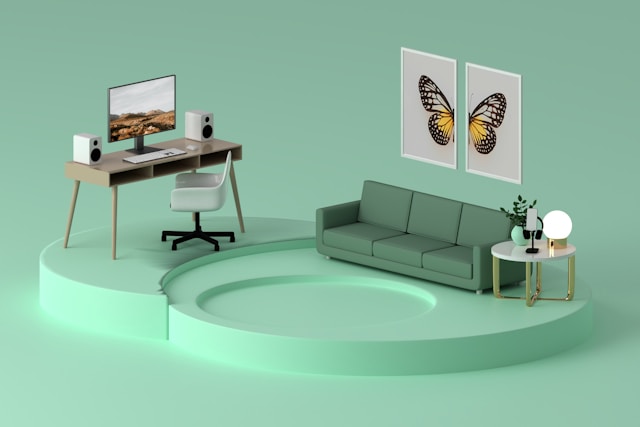
3D websites aren’t just a novelty — they’re a strategic advantage for industries where experience, atmosphere, and visual storytelling are central to how business gets done. As interactive websites continue to prove their impact on engagement, the question is no longer whether 3D will find its place on the web, but which industries will lead the adoption.
While virtually any business can benefit from standing out online, some industries are particularly well-suited for the shift from flat pages to immersive spaces. Here are five that stand to gain the most — and why.
1. Real Estate and Interior Design
Real estate has always been about showing, not telling. A written description of a “spacious, light-filled living room” can only do so much. Photos help, and floor plans provide useful context, but none of these formats capture the actual feeling of walking through a space.
This is where 3D websites offer a transformative advantage. Virtual walkthroughs allow potential buyers to explore properties interactively, moving through rooms at their own pace and getting a genuine sense of layout, proportion, and atmosphere. Interior designers can showcase their concepts in context — not as flat mood boards, but as explorable environments where clients can see exactly how a space will feel.
According to the National Association of Realtors, over ninety-five percent of home buyers use the internet during their property search, and listings with interactive features consistently outperform static ones in engagement and inquiry rates. The reason is straightforward: buying a home is an emotional decision, and a 3D experience that lets someone feel a space creates a connection that photographs simply can’t match.
For real estate agencies and interior design studios, 3D websites don’t just look impressive — they shorten sales cycles and build buyer confidence before a single in-person visit takes place.
2. Creative Portfolios and Design Studios
For designers, artists, photographers, and creative professionals, the portfolio is the product. It’s the first impression, the proof of skill, and the basis on which clients make hiring decisions. And yet, most creative portfolios look remarkably similar: a grid of thumbnails on a flat page, built from the same handful of templates that thousands of other creatives are using.
A 3D website changes this dynamic entirely. Instead of presenting work in a generic grid, a creative professional can build an immersive gallery where visitors walk through themed rooms, each showcasing different projects or styles. The website itself becomes a demonstration of creative vision — not just a container for past work, but a piece of the portfolio in its own right.
This matters because creative professionals are, by definition, selling creativity. A website that looks like everyone else’s undermines that value proposition before a single portfolio piece is viewed. A 3D space that visitors can explore signals imagination, originality, and technical sophistication — exactly the qualities clients are looking for.
3. Hospitality and Tourism
Hotels, restaurants, resorts, and travel companies are in the business of selling experiences. The problem is that most hospitality websites struggle to convey what an experience actually feels like. They follow a predictable formula: a hero image, a list of amenities, a photo gallery, and a booking form. The result is functional but emotionally flat.
3D websites offer hospitality businesses something far more powerful: the ability to let potential guests experience a venue before they book. Imagine being able to walk through a boutique hotel’s lobby, peek into the restaurant, and explore the rooftop terrace — all from your browser. The atmosphere, the design details, the mood of the space all come through in ways that a carousel of photographs never could.
This is particularly valuable in an industry where differentiation is everything. When every competitor’s website follows the same template, a 3D experience creates an immediate competitive advantage. Travelers who can virtually experience a venue before booking feel more confident in their decision, which translates directly into higher conversion rates and fewer cancellations.
4. E-Commerce and Product Showcases
Online shopping has revolutionized retail, but it hasn’t solved one fundamental problem: products on a screen don’t feel the same as products in your hands. Flat product photos and written descriptions only tell part of the story, and the gap between expectation and reality is the primary driver of returns.
3D websites address this by placing products inside virtual environments where customers can see them in context. Furniture displayed in a realistic room setting gives buyers a sense of scale and style that a white-background photo cannot. Artwork shown hanging on a virtual wall communicates its presence in a way that a flat image misses. Fashion items presented in a curated virtual boutique create a premium shopping experience that elevates the entire brand.
Beyond reducing returns, this approach increases purchase confidence and average order values. When customers can interact with products in a three-dimensional space, they develop a stronger sense of what they’re buying — and they’re more willing to commit.
5. Education and Online Learning
Online education is booming, but the user experience hasn’t kept pace with the demand. Most learning platforms are essentially text, video, and quizzes stacked on a flat page. The format is functional, but it doesn’t leverage what we know about how people actually learn.
Research consistently shows that spatial learning improves retention. When students can explore concepts in a three-dimensional environment — walking through a virtual laboratory, examining models from different angles, or navigating an interactive timeline — they understand and remember more than they would from reading alone.
3D websites open up exciting possibilities for educators: interactive classrooms, virtual field trips, explorable science exhibits, and immersive historical reconstructions. These aren’t far-future fantasies — the technology exists today, and tools like Voxxly make it possible to build these experiences without specialized technical skills.
Beyond the Top Five
Several other industries are well-positioned to benefit from the shift to 3D. Event companies can create virtual exhibition halls and conference spaces. Architecture firms can present projects as explorable environments rather than flat renderings. Gaming and entertainment companies can build promotional sites that match the energy and immersion of their products. And wellness brands — yoga studios, spas, meditation apps — can create calming, atmospheric web experiences that align perfectly with their brand identity.
Getting Started Is Easier Than You Think
The common thread across all these industries is that experience matters more than information alone. When your website can make visitors feel something — whether that’s the warmth of a cozy room, the elegance of a gallery, or the excitement of exploring a new space — engagement and conversion follow naturally.
The no-code revolution has made it possible for anyone to create professional 3D websites without a development team or 3D expertise. With Voxxly, you choose your room style and size, customize the colors, textures, and atmosphere, place your content with drag and drop, and publish your 3D website instantly.
Every industry where experience matters is a natural fit for 3D. The question isn’t whether 3D websites will become mainstream — it’s which businesses will adopt them first and capture the advantage while the field is still wide open.