
The no-code revolution has transformed how we build for the web. Over the past decade, tools like Wix, Squarespace, and Webflow have made it possible for anyone — regardless of technical skill — to create professional-looking websites. What once required a developer and thousands of dollars can now be done in an afternoon with a drag-and-drop editor.
But as we move through 2026, a question is emerging that the industry hasn’t fully answered yet: What actually comes next?
The Plateau Problem
No-code website builders have matured impressively. They offer responsive design out of the box, sophisticated animation tools, CMS capabilities, e-commerce integrations, and pixel-perfect editors that would have seemed like science fiction fifteen years ago.
And yet, something feels off. Despite all this technological progress, the websites being created today look remarkably similar to each other. Scroll through the portfolios of freelance designers, the landing pages of SaaS startups, or the homepages of small businesses, and you’ll notice a striking visual homogeneity. Hero section, three-column feature grid, testimonials, footer. Repeat.
This isn’t a failure of the tools — it’s a natural consequence of millions of users building from the same template libraries. The creative output has plateaued even as the technology beneath it has continued to advance. We’re building websites faster than ever, but we’re not building them differently.
Why 3D Changes Everything
What if the next evolution of no-code isn’t just a better editor or more templates — but an entirely new dimension?
3D web design represents a fundamental shift in how websites are created and experienced. Instead of arranging content on a flat, two-dimensional canvas, creators can build immersive spaces that visitors explore rather than scroll. This isn’t a minor upgrade — it’s a rethinking of what a website can be.
The timing for this shift couldn’t be better. WebGL, the browser technology that enables real-time 3D rendering, has reached a level of maturity and browser support that makes it viable for mainstream use. Modern devices — even mid-range smartphones — pack enough GPU power to handle lightweight 3D scenes smoothly. And low-poly design, a visual style that’s both stunning and performance-friendly, provides the perfect aesthetic bridge between creative ambition and technical reality.
What was missing was a tool that could make all of this accessible to people who aren’t developers or 3D artists. That’s the gap Voxxly is designed to fill.
More Than a Gimmick
Skeptics might argue that 3D on the web is just a novelty — flashy but impractical. The data tells a different story.
Interactive 3D environments demonstrably keep users on websites longer. The exploratory nature of spatial websites — where visitors navigate through rooms rather than scroll through pages — significantly increases time-on-page and reduces bounce rates. These aren’t just engagement metrics to feel good about; they’re signals that directly influence search engine rankings.
There’s also the branding advantage. In a marketplace where every competitor’s website looks like a variation on the same template, a 3D website instantly creates differentiation. Visitors remember spaces in a way they simply don’t remember pages. The emotional resonance of stepping into a cozy virtual room, an elegant showroom, or a vibrant creative studio creates brand impressions that flat layouts can’t compete with.
And contrary to what you might expect, modern 3D websites (like those built with Voxxly) are fully compatible with search engines. They maintain a standard HTML structure underneath the 3D layer, which means search engines can crawl and index them just like any traditional website. You get the visual impact of 3D without sacrificing discoverability.
How Voxxly Approaches This Differently
Voxxly isn’t trying to add 3D effects to flat pages — that approach has been tried and tends to produce gimmicky results. Instead, Voxxly takes a fundamentally different approach: you build rooms, not pages.
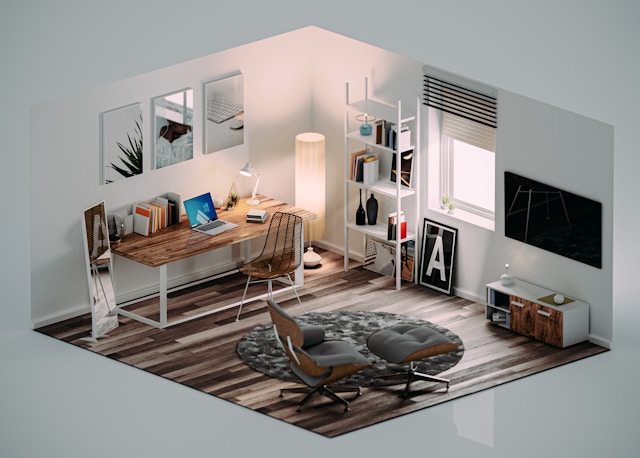
Your website is a three-dimensional space. You customize the walls, floors, lighting, and atmosphere to set the mood. You place objects, text, and content within the scene. And when you’re happy with what you’ve created, you publish it with a single click. The entire workflow is drag-and-drop, and the result is a fully interactive 3D website that looks like nothing else on the internet.
Because Voxxly is built on low-poly design principles, the resulting websites are lightweight and fast-loading despite their visual richness. They’re responsive across devices, optimized for SEO, and accessible to anyone with a modern browser.
What the Future Holds
The no-code 3D space is still young, but the momentum is building rapidly. In the coming years, we can expect to see more industries embracing 3D websites as a standard rather than a novelty — real estate, hospitality, education, and retail are all natural early adopters. Template marketplaces for 3D environments will emerge, giving creators pre-built rooms and scenes they can customize. E-commerce will evolve from flat product pages to virtual showrooms where customers browse spatially. And AI-assisted 3D design will eventually allow creators to generate layouts and scenes from simple text descriptions.
The foundation is already in place. Browsers support it. Devices can handle it. The visual language of low-poly makes it performant. The only thing that was missing was a tool simple enough for everyone to use.
The no-code revolution democratized web creation. The 3D revolution will democratize web experiences. And tools like Voxxly are making sure you don’t need to be a developer or a 3D artist to be part of that future.