
Web design has evolved dramatically over the last two decades. From static HTML pages to responsive layouts to today’s no-code tools like Wix and Webflow — the tools changed, but the foundation stayed the same: websites are flat.
They are built from images, text boxes, buttons, and sections stacked on top of each other.
But what if websites were no longer just pages
— but spaces?
Today, we take a direct look at how traditional 2D websites compare to immersive 3D web spaces — and why this shift is already underway.
The Limitations of Traditional 2D Websites
2D websites do their job — as long as you stay within their boundaries. They’re quick to build, familiar to users, and easy to navigate. But they only allow for one type of interaction: scrolling and clicking.
Some typical limitations of 2D layouts:
- Content is arranged linearly
- Interaction is minimal
- Brand experiences are limited to visuals and typography
- There is no spatial memory — only interface memory
2D is functional, but fundamentally limited.
The Step Into the Third Dimension
3D web spaces, like the ones we’re building with Voxxly, break this model completely. Instead of creating “pages,” you create “rooms.” Users don’t just scroll — they enter a digital environment.
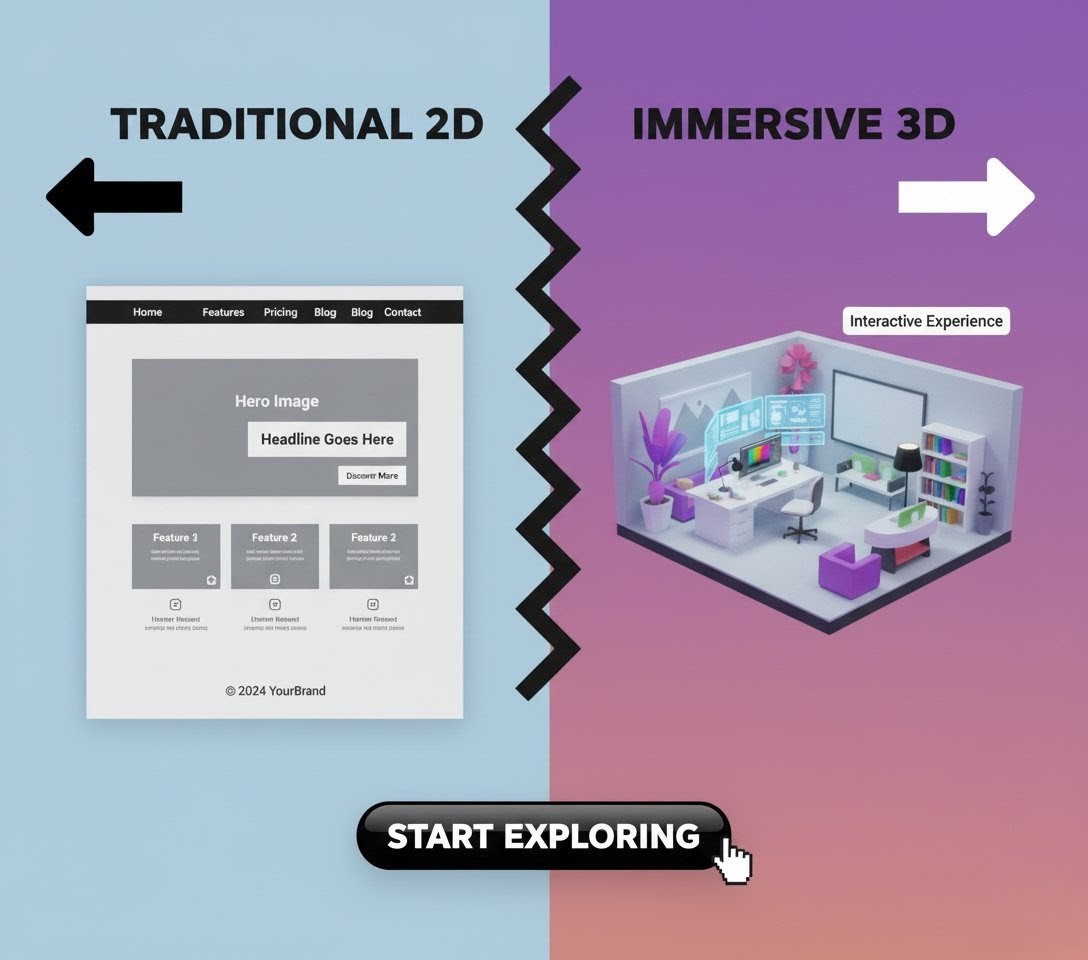
A simple example:
Left: a traditional 2D layout with text, image, and call-to-action
Right: a 3D interpretation of the same content — but displayed inside a walkable, interactive scene.
The information is identical.
The experience is entirely different.
What Changes With 3D?
1. Content becomes spatial instead of linear
Rather than stacking sections vertically, elements live in a room. Users move through the environment instead of scrolling. This naturally boosts engagement and curiosity.
2. Brands become experiential
A 3D space conveys atmosphere, identity, and emotion in ways a flat layout never could. Light, depth, materials, and scale all become part of the storytelling.
3. Interaction becomes intuitive
Objects can be picked up, opened, walked around or activated — just like in real life. It feels playful and natural, even for users with zero gaming experience.
4. Stronger memory and longer engagement
Our brains are built to remember spaces. A room is inherently more memorable than a webpage. This translates into higher retention and significantly longer time-on-page.
Why the Before/After Comparison Matters
Many still believe 3D is “just a gimmick.”
But the direct comparison shows the opposite:
3D doesn’t replace 2D — it amplifies it.
The content stays the same.
The impact multiplies.
3D turns webpages into experiences. Into places. Into something you don’t just see — you visit.
What Makes Voxxly Different
Voxxly brings immersive spaces into the mainstream by making them as easy to build as a website. Instead of designing layouts, you arrange objects in a room — like furnishing a space in a video game, but with real business use cases.
No design background needed.
No technical skills.
No 3D software.
Fully SEO-capable.
Optimized performance with baked lighting & lightweight models.
The result:
A web space that feels like a mini-metaverse, built with drag-and-drop.
Conclusion: The Future of the Web Won’t Be Flat
2D websites won’t disappear. But they will be complemented — and often outperformed — by immersive 3D experiences that make brands more memorable, interactive, and emotionally engaging.
The before/after comparison makes it clear:
The question isn’t if the web is moving toward 3D.
It’s when you decide to take advantage of it.
Voxxly is building that future.
And we’re only getting started.