
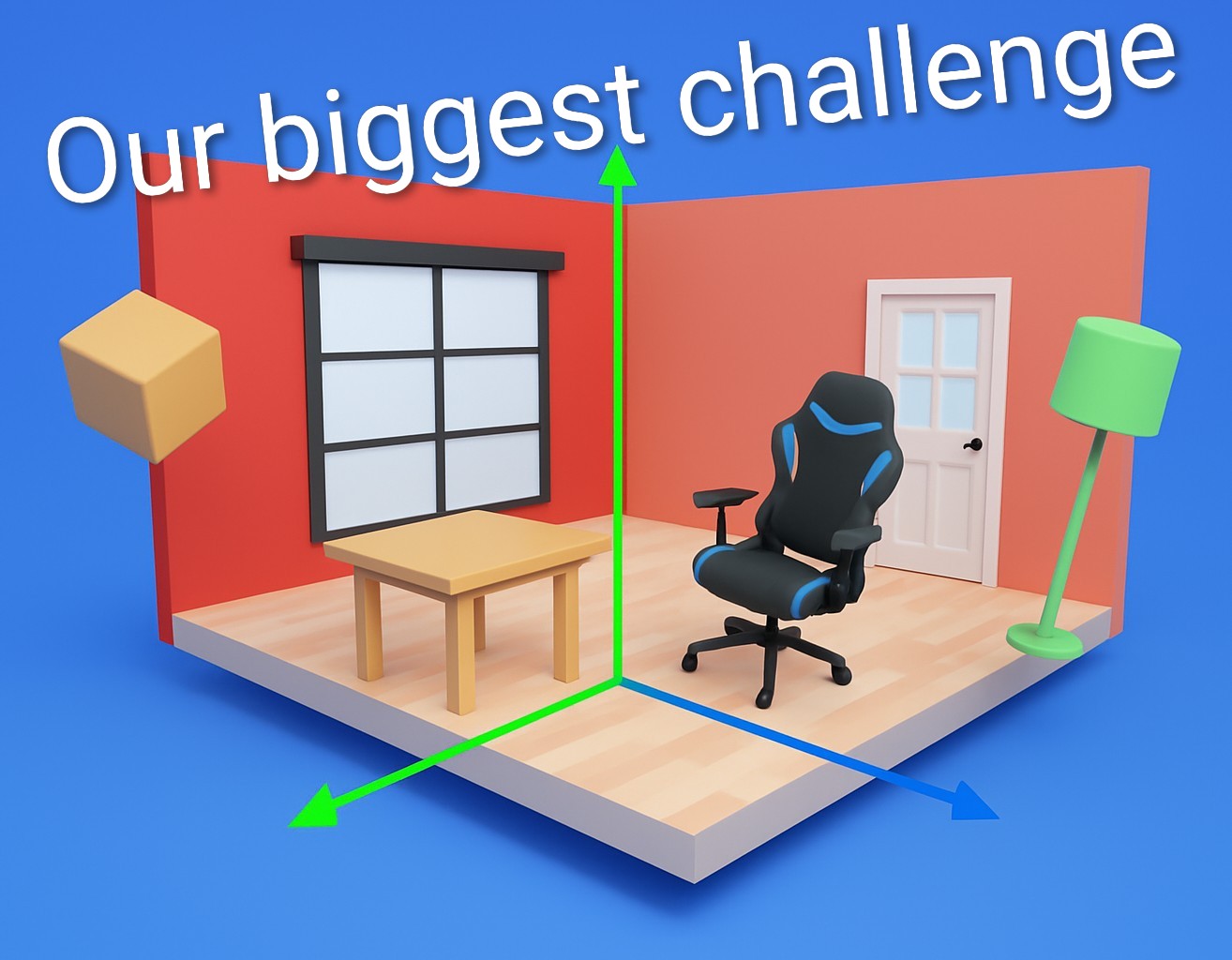
When you see a 3D object smoothly sliding across a virtual room, it looks simple — almost too simple.
You click, drag, and drop. Done.
But behind that effortless motion lies one of the trickiest challenges in interactive 3D development: true spatial freedom.
Why It’s So Hard
In a 3D environment, every movement exists within three axes — X, Y, and Z. Each action the user takes has to be translated into precise spatial coordinates. But that’s only the beginning.
When you move an object, the system must:
- Recalculate its position in real time
- Detect collisions with other objects or walls
- Update perspective
- Keep everything responsive and intuitive for the user
That balance between accuracy and simplicity is the core of the challenge. The interface should feel natural — yet under the surface, a complex system of math and logic is constantly working to make it seem effortless.
Our Approach at Voxxly
At Voxxly, we’re currently building the foundation for that smooth movement. Our goal is to make creators forget about coordinates and focus purely on design.
To achieve this, we’re experimenting with:
- Adaptive drag mechanics that respond to depth and surface detection
- Collision boundaries to keep objects from “clipping” through walls
- Camera alignment logic that adjusts automatically while you move objects in space
The challenge is not just technical — it’s about feeling. The user should never notice the complexity. It should “just work.”
The Vision Ahead
We believe the future of 3D creation lies in intuitive interfaces — tools that make the complexity invisible.
Once this system is complete, users will be able to design fully interactive rooms, showrooms, and scenes directly in the browser — no 3D experience required.
It’s one of those small details that will make a huge difference in how people interact with 3D content online.