
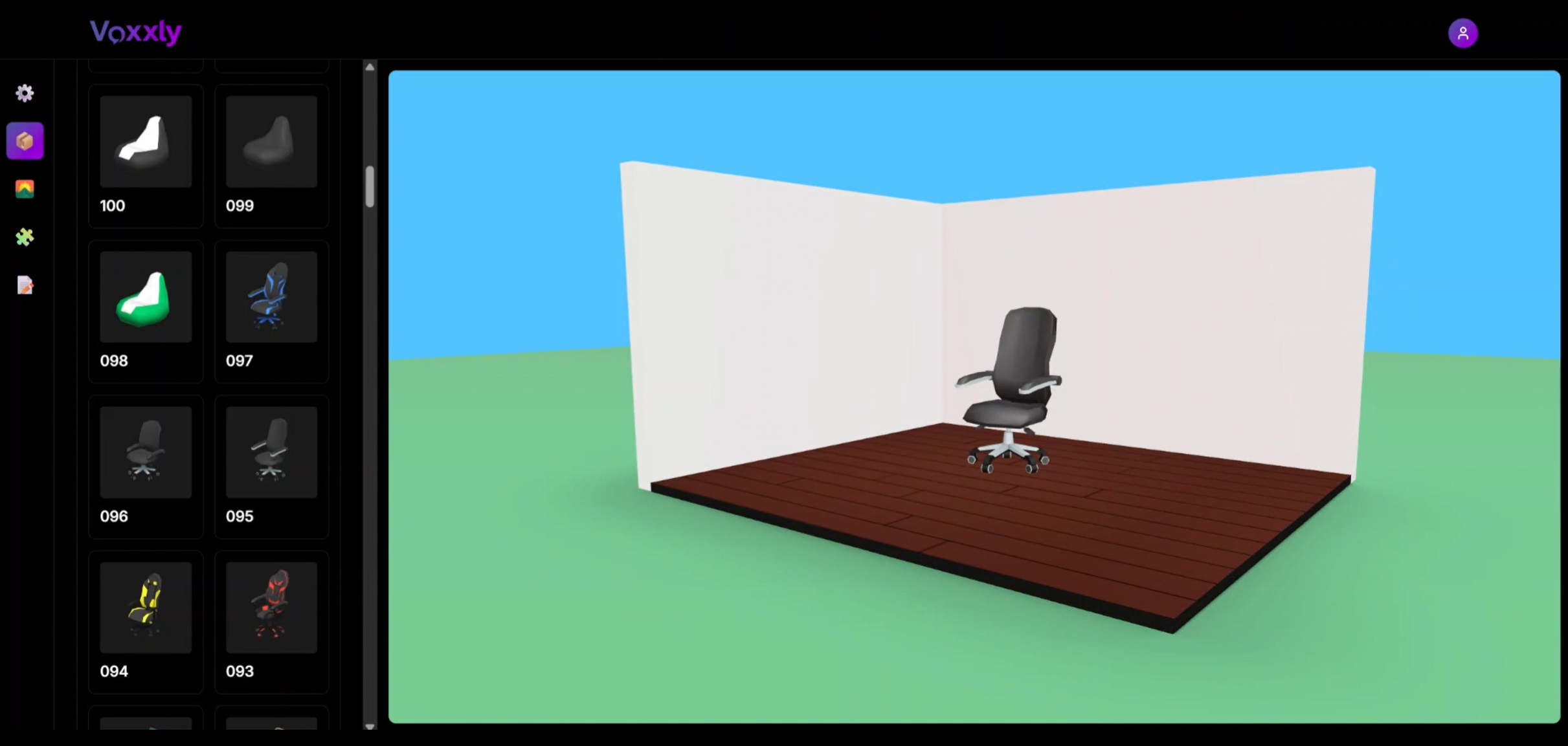
Over the past months, we’ve been on an exciting journey — transforming the idea of 3D websites from concept to reality. With every update, Voxxly is getting closer to its vision: making the web more immersive, creative, and personal than ever before.
And now, a major step in that direction has just been achieved: users can load and freely place 3D objects directly into their scene.
This new capability is more than just a feature. It’s the foundation of how Voxxly will revolutionize website creation — by turning it into a process that’s as intuitive and visual as arranging furniture in your own home.
From Flat Pages to Living Spaces
Traditional websites have always been built in 2D — structured grids, flat backgrounds, static layouts. They’ve served us well for decades, but the internet has evolved.
People crave experiences now, not just information. They want to feel something when they visit a website — to be immersed, engaged, and inspired. That’s exactly what Voxxly aims to deliver.
By using low-poly 3D technology, Voxxly makes it possible to design entire virtual spaces that act as your website. Whether it’s a minimalist office, a cozy studio, a creative portfolio room, or a digital storefront — every space can be uniquely yours.
And with our new object placement system, this vision is becoming more tangible than ever.
Build Your Website Like You Build a Room
The latest Voxxly update introduces the ability to import and position 3D objects right inside your workspace. Imagine placing a table in the center of your scene, hanging art on the walls, or adding small decorative details to set the mood.
Every object can be moved, rotated, resized, and aligned exactly how you want. The goal is to give you the same feeling of freedom and creativity that you have when decorating a real-world space — only now, your “room” lives on the web.
And this isn’t just for designers or developers. Voxxly’s no-code interface means anyone can do it — from freelancers and small businesses to artists, coaches, and brands who want something truly different.
The Power Behind the Simplicity
What makes this possible is Voxxly’s proprietary low-poly 3D engine. Every model, texture, and lighting effect is optimized for lightning-fast performance, ensuring that even complex environments load in seconds — without sacrificing quality.
This lightweight design approach allows 3D websites created with Voxxly to stay SEO-friendly and responsive. Pages maintain a standard HTML structure, include meta data, and can be enriched with text, links, and media — just like any other modern website.
So while they look like interactive 3D worlds, they behave technically like normal, crawlable web pages. That means they’re visible to Google, fast on mobile, and accessible to users across all devices.
Why This Update Matters
Allowing users to place and arrange objects freely may sound simple — but it’s a fundamental building block of what Voxxly is all about.
It brings us one step closer to a future where websites are not just tools, but digital experiences.
A future where anyone can design a virtual space that expresses their identity — without needing to code, design, or render anything manually.
Every new feature we release takes Voxxly further toward its mission:
to make 3D website creation as easy as building with blocks.
What’s Next for Voxxly
Now that object placement is live, our next steps will focus on expanding the asset library and adding even more customization options. Soon, creators will be able to choose from hundreds of materials, colors, lights, and prebuilt room templates to jumpstart their designs.
Later, Voxxly will introduce advanced publishing tools, allowing users to connect their domains, add analytics, and even integrate interactive elements like links, buttons, and embedded media.
Every update brings us closer to a fully functional 3D web builder — one that empowers anyone to build, publish, and share their own 3D space online.
The Web Is Changing — and We’re Building What Comes Next
Voxxly isn’t just a product. It’s a movement toward a new kind of internet — one that’s more visual, more human, and more creative.
We believe the next evolution of the web won’t be flat.
It will be spatial, interactive, and alive.
And it starts here.