
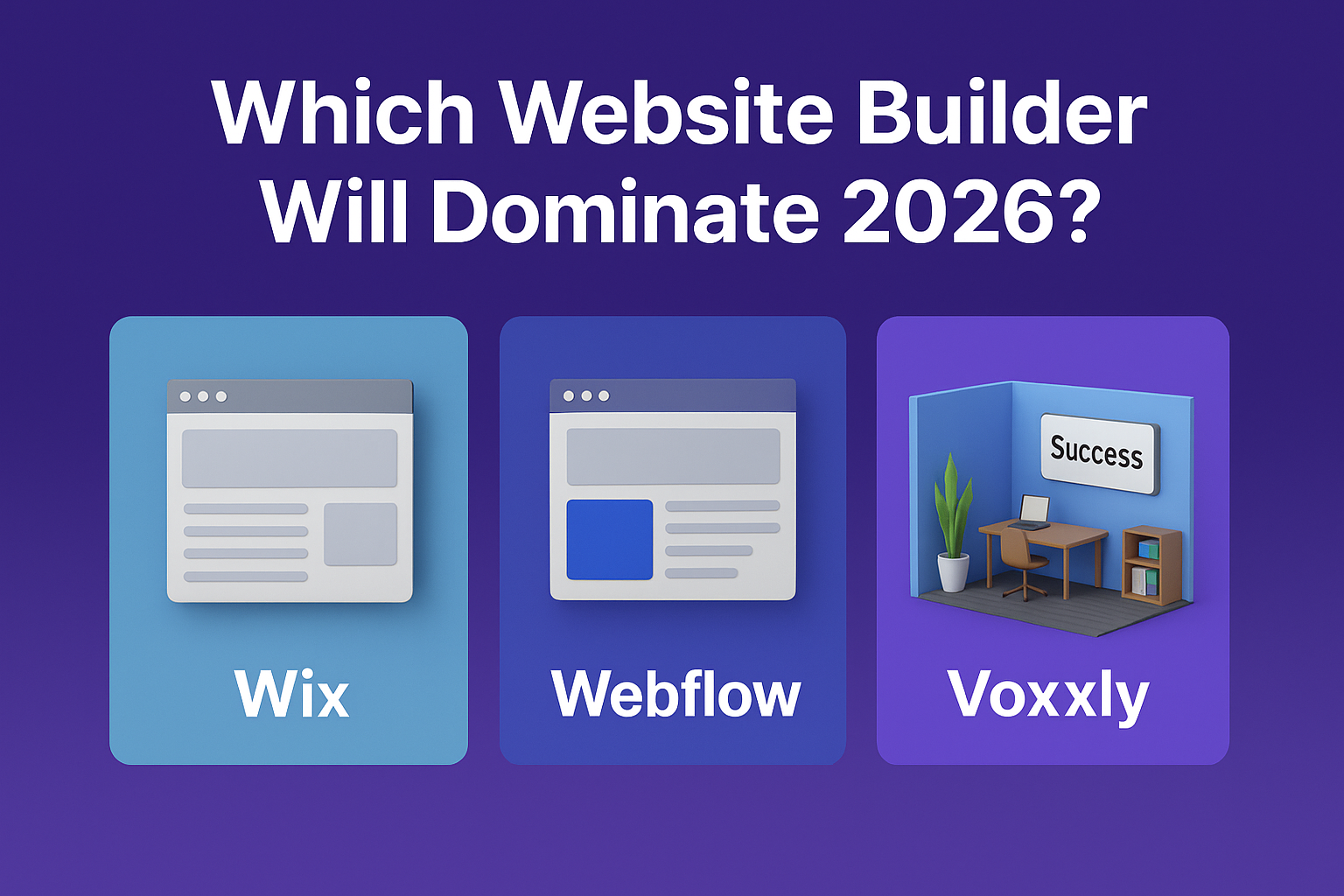
For more than a decade, Wix and Webflow have dominated the no-code website builder landscape. Wix is known for simplicity and accessibility, while Webflow stands out through its flexibility and professional design freedom. But the digital world is evolving. Interactivity, immersive online experiences, and 3D environments are becoming mainstream expectations rather than niche experiments.
A new contender enters the field and challenges the foundations of traditional web creation: Voxxly, the world’s first drag-and-build 3D website builder.
This leads to an important question:
Which platform is best positioned to lead the next era of web creation?
1. Ease of Use
Wix
Wix is mainly built for beginners. Its visual editor and templates make it easy to create quick websites. However, customization is limited, especially when trying to modify layouts beyond the template’s structure.
Webflow
Webflow provides extensive control, combining visual design with CSS-level precision. This makes it extremely powerful but also more complex. Beginners often struggle with the steep learning curve.
Voxxly
Voxxly introduces a completely new type of editor. Instead of editing flat templates, users build a 3D room. They drag objects into a space, arrange them, adjust materials, and publish instantly. It requires no design or technical skills and does not impose template limitations.
2. Creative Possibilities
Wix
Wix offers creative templates, but customization beyond these templates can break layouts and limit flexibility.
Webflow
Webflow remains the most flexible tool for 2D layouts. Designers can achieve nearly anything within the boundaries of flat design.
Voxxly
Voxxly pushes creativity beyond 2D entirely. Users can design 3D spaces with rooms, props, furniture, 3D objects, and custom textures. This form of spatial design allows users to create virtual environments that reflect personality and brand identity in a way no 2D layout can achieve.
3. Performance and Loading Speed
Wix
Wix websites are fast, but can be slowed down by heavy scripts and third-party integrations.
Webflow
Webflow offers clean code, optimized hosting, and strong performance.
Voxxly
Despite being 3D-based, Voxxly websites load extremely fast thanks to optimized models, baked lighting, efficient WebGL rendering, and SEO-friendly markup. These technical optimizations allow Voxxly pages to compete with or exceed traditional 2D pages.
4. SEO Capabilities
Wix
Wix provides good SEO tools but has historically lagged behind Webflow in technical SEO structure.
Webflow
Webflow leads in the SEO category with clean code, customizable metadata, and fast hosting.
Voxxly
Voxxly brings SEO into the world of 3D by supporting metadata, custom URLs, internal linking, fast loading times, and significantly increased dwell time through interactivity. It sets a new benchmark as the first SEO-ready 3D website builder.
5. Innovation and Future Potential
Wix
A reliable and stable platform, but not focused on groundbreaking innovation.
Webflow
A strong ecosystem with continuous improvements but still rooted in traditional 2D web layouts.
Voxxly
Voxxly redefines the concept of a website. It introduces 3D spaces, interactive brand storytelling, spatial design, and no-code 3D creation for everyone. Instead of improving the traditional web model, it reinvents it.
Comparison Table
| Feature | Wix | Webflow | Voxxly |
|---|---|---|---|
| Ease of Use | High | Medium | High |
| Creative Freedom | Medium | High | High |
| Performance | Medium | High | High |
| SEO | High | Very High | High |
| Innovation Level | Low | High | Very High |
| 3D Capabilities | No | No | Yes |
| Best For | Beginners | Designers | Users who want to stand out |
Conclusion: Which Platform Will Lead in 2026?
Wix and Webflow will continue to play major roles in the website builder market. Both are reliable and widely used, but both remain tied to the limitations of conventional 2D web design.
Voxxly, however, breaks these boundaries entirely. It introduces an interactive and future-ready platform that turns websites into digital spaces rather than flat pages. As users expect richer and more engaging online experiences, tools that support 3D creation will naturally gain momentum.
The future of the web is not flat.
It is three-dimensional, and Voxxly is building that future.