

Every website faces the same fundamental challenge: keeping visitors engaged long enough to take action. Whether that action is signing up for a newsletter, making a purchase, or simply remembering your brand the next time they need what you offer, engagement is the metric that makes everything else possible.
The problem is that most websites are passive experiences. Visitors arrive, scroll through a page of text and images, and leave. The average time spent on a webpage across the internet is under sixty seconds, and bounce rates regularly exceed fifty percent. For most businesses, that means more than half of their visitors disappear before engaging with anything meaningful.
But what if the solution isn’t better headlines or more compelling images? What if the real breakthrough lies in changing the fundamental nature of the experience itself?
Why Interactivity Matters More Than You Think
Research in UX design and behavioral psychology has consistently demonstrated that interactivity is one of the most powerful drivers of engagement. When users actively participate in an experience rather than passively consuming it, their relationship with the content changes in meaningful ways.
The first mechanism at work is cognitive investment. When a visitor interacts with your website, clicking, dragging, exploring, making choices, they invest mental effort into the experience. That investment creates a psychological sense of ownership. People who feel invested in something are significantly less likely to abandon it, which is why interactive experiences consistently outperform static pages in time-on-site metrics.
The second mechanism is what psychologists call curiosity loops. Interactive elements naturally trigger questions: What happens if I click this? What’s behind that element? What will I discover next? Each micro-moment of discovery creates a small reward that motivates further exploration. This is the same psychological principle that makes games so engaging, and it works just as powerfully on websites.
The third mechanism is emotional engagement. Static pages communicate information, but interactive spaces create feelings. A warm, inviting virtual room evokes comfort and trust. A sleek, modern gallery conveys professionalism and sophistication. These emotional responses form brand impressions that are far more durable and influential than anything a flat webpage can produce.
The Numbers Behind Interactive Design
The impact of interactivity on website performance isn’t theoretical, it’s measurable and consistent across industries.
Interactive content typically generates visit durations two to three times longer than static equivalents. That’s not a marginal improvement; it’s a fundamental shift in how visitors relate to your content. Bounce rates on interactive sites tend to drop by twenty to forty percent, meaning significantly more visitors stick around long enough to see your value proposition and consider taking action.
Conversion rates tell an equally compelling story. Interactive landing pages have been shown to improve conversions by up to forty percent compared to their static counterparts. And interactive content is shared on social media roughly twice as often as static content, creating organic reach that compounds over time.
These metrics aren’t just numbers to celebrate in a marketing meeting. They directly impact revenue, and increasingly, they influence search engine rankings as well.
How 3D Takes Interactivity to Another Level
Traditional interactive elements, hover effects, scroll-triggered animations, embedded quizzes, are genuine improvements over completely static pages. But they still operate within the same fundamental paradigm: a flat page that the user scrolls through from top to bottom.
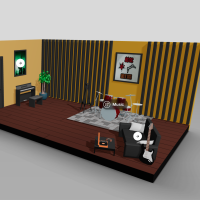
3D environments represent a qualitative leap beyond that paradigm. In a three-dimensional space, visitors don’t scroll, they explore. They navigate through rooms, discover content placed within meaningful contexts, and engage with your brand spatially. This fundamentally changes the relationship between the visitor and the website.
The reason this works so well is deeply rooted in human nature. We are spatial creatures. Our brains evolved to navigate and understand three-dimensional environments, and we’ve been doing it every day of our lives. A 3D website taps into this innate capability, making the experience feel intuitive rather than learned. There’s no instruction manual needed for exploring a room.
Context is another powerful advantage. In a 3D space, content doesn’t just sit in a grid, it exists within an environment. A product displayed on a virtual shelf feels different from a product photographed on a white background. A portfolio piece hanging on the wall of a stylish gallery carries more weight than a thumbnail in a grid. A testimonial displayed on a sign within a welcoming virtual room feels more personal than text in a carousel. The environment itself becomes part of the message.
Perhaps most importantly, people remember places better than they remember pages. A 3D website creates a spatial memory, visitors can recall the experience of being in a space in a way that flat websites simply cannot replicate. This translates directly into stronger brand recall and a higher likelihood of return visits.
What This Means for Search Rankings
Google’s ranking algorithm has been steadily shifting toward user experience signals as core ranking factors. This trend directly favors interactive, engaging websites.
Core Web Vitals reward sites that are fast, responsive, and visually stable. Low-poly 3D websites, like those built with Voxxly, are inherently lightweight and meet these performance benchmarks comfortably. The exploration-based navigation model naturally increases session duration, which Google interprets as a signal that the content is valuable and relevant. Reduced bounce rates reinforce that signal. And because Voxxly maintains a standard HTML page structure underneath the 3D experience, search engines can crawl and index the content just as effectively as they would any traditional website.
In other words, a well-built 3D website doesn’t just look impressive, it sends exactly the kind of user experience signals that modern search algorithms are designed to reward.
Practical Strategies for Better Engagement
Whether or not you’re ready to go fully 3D, the principles of interactive engagement can improve any website. Start by reducing friction, make navigation intuitive and ensure your site loads quickly. Create moments of discovery that reward visitors for exploring beyond the first fold. Use visual storytelling to show rather than tell, and consider how even small interactive elements like hover effects and scroll animations can add layers of engagement.
Design with emotion in mind. Colors, lighting, spacing, and atmosphere all shape how visitors feel when they land on your site, and those feelings determine whether they stay or leave. And whenever possible, think spatially, consider how pieces of content relate to each other and to the overall environment, rather than just stacking them in a linear sequence.
For those ready to take the full leap, Voxxly makes it straightforward to build immersive 3D websites that put all of these principles into practice, even without coding knowledge. The drag-and-drop 3D editor lets you create rooms with customizable atmospheres, place content spatially, and publish instantly with full SEO support.
The web is shifting from passive consumption to active exploration. Interactive 3D websites aren’t just visually impressive, they’re measurably more effective at keeping visitors engaged, reducing bounce rates, and driving conversions. And with tools like Voxxly, creating these experiences has never been more accessible.